What SIX does
Post traumatic stress is a physiological condition before it is anything a survivor can describe. When a trigger occurs, the event does not begin in language and it does not wait for reflection. It begins in the body, in real time. The nervous system reads danger, and the body answers: heart rate shifts, heart rate variability collapses or climbs, electrodermal activity rises as sweat glands recruit, movement changes, breathing changes, and the autonomic system enters a threat state even when the surrounding world looks ordinary to everyone else in the room. A post traumatic stress trigger is more than a memory, a feeling, or a story told afterward. It is a measurable physiological event, and it happens whether or not the survivor can later explain it.
Post traumatic stress leaves that evidence while it is happening, and it is the most direct record of the injury that exists. SIX is a wrist-worn post traumatic stress monitoring device built to capture it at the moment it is produced, continuously, while the survivor lives an ordinary life.
SIX reads six integrated sensors on the wrist: cardiac rate and heart rate variability, electrodermal activity, movement, environmental sound, ambient light, and location at confirmed events. It runs twenty-four hours a day without asking the wearer for anything. It answers one question, again and again. Was that a post traumatic stress trigger, or was it something else. Diagnosis, treatment, and the question of why an episode happened all stay with the clinician.
Why the measurement must be personal, not population-based
My PTSD is different from everybody else's, and I know that was one of the things I was running into — everybody's PTSD is different, so why the hell are they still using population averages?
Post traumatic stress is profoundly individual, and this individuality is not noise to be averaged away. It is the central fact that any honest monitoring system has to respect. One survivor responds to a trigger with strong heart rate acceleration and sympathetic activation. Another freezes, blunts, shuts down, or dissociates, showing little of the elevation the first survivor shows. The same class of trauma cue can produce opposite physiological patterns in two different people, depending on their physiology, their trauma history, and their state in that moment. A population rule cannot capture this. A generic stress score, computed against averages taken from other people's bodies, cannot explain any one survivor's personal trigger pattern, and it will misread freeze and dissociation as calm precisely when the survivor is in the most danger.
No population averages. SIX learns you. From the day you put it on, it learns yours — and what it learns is yours. It can't be handed to someone else and it can't be rebuilt on a blank device. That is also what lets it work in a real life. Exercise changes what your body does. So do medications, a comorbid condition, substance use — and recovery itself. Any system built on averages has to figure out which one of those it is looking at before it can say anything at all. SIX never has to answer that question. It reads you, so everything that isn't post traumatic stress stops being noise it has to explain.
The point is never simply whether heart rate went up. The point is what a trigger looks like in this survivor's body, and to keep learning that as the body changes over time.
What the clinician receives
Because of my fight with it I have realized how currently it is invisible to anyone really looking for it. You can't fight an enemy you can't see, right. I thought that seeing the triggers happen would give me and the medical teams something to see so we could know when treatment or medications were or were not working.
Current post traumatic stress care usually does not capture the physiological event when it occurs. The standard path is reconstruction. A survivor experiences an episode alone, at home or in public, during sleep, at work, in a car, in a store, in a private moment when no clinician is present. Sometime later, they try to describe it. That description has to travel through fear, dissociation, shame, confusion, panic, freezing, and exhaustion before it reaches a clinician. The survivor may not remember the sequence clearly. The survivor may underreport because of stigma. The survivor may have no words for what happened at all. The clinician then has to interpret an episode without any direct record of what the survivor's body actually did during the trigger.
None of this replaces the clinician. SIX gives clinicians a kind of evidence they have rarely had: objective physiological data drawn from the survivor's real daily life instead of from a recalled session or a simulated cue in an office. That evidence supports clinical judgment instead of substituting for it.
For medical professionals, the device exposes a user-controlled data interface. Trigger frequency over time. Intensity distribution. Geographic patterns from where trigger events occurred. Temporal distributions across the day and across weeks. Whether the condition is improving — fewer triggers, lower intensity, less time in trigger states — or deteriorating.
This data transforms therapy. Sessions stop being trigger archaeology — the wearer trying to remember what set them off three days ago — and start being targeted intervention against patterns the wearer and the clinician can both see. Exposure therapy can be planned around specific triggers and intensity levels. Medication effectiveness can be measured against actual physiological response, not subjective self-report. Crisis prediction becomes possible as patterns of increased vulnerability emerge in advance. Treatment compliance is verifiable through outcome rather than questionnaire.
For the wearer, the same data is recovery evidence. Trigger frequency dropping. Intensity decreasing. Faster physiological recovery after triggers. Fewer pre-nightmare interventions night over night. These are quantifiable proofs of healing — visible to a population that has often had to take healing on faith. The clinician sees the trajectory. The wearer sees the trajectory. The support person, through fewer Buddy Band activations, feels the trajectory. The broken leg is healing, and everyone can see.
The wearer chooses what to share with which clinician. Nothing leaves the local system without explicit permission.
Recovery becomes measurable
I wish I had a scar, a bruise, or a cast. Something so others could know if I was hurt, or if I was getting better.
Post traumatic stress recovery often feels uncertain to the person living it, and uncertainty erodes the will to continue. When trigger frequency falls, when intensity drops, when physiological recovery after an episode grows faster, when sleep steadies and nighttime disturbances ease, those changes can be seen instead of merely hoped for. Survivors frequently need proof that progress is real, and clinicians need clear evidence that a treatment is working or failing. SIX exists in part because invisible improvement should be as measurable as invisible injury. The same physiology that records the wound can record the healing.
The Buddy Band
I watched my wife and daughter stand like deer in the headlights when I would drop my keys and yell and I couldn't let them do that anymore. Me being home after the injury to my neck and not working for several years I got tired of being the bad guy when I wasn't the bad guy — so that's why the buddy band was created.
A post traumatic stress episode does not stay contained inside one nervous system. It reaches into relationships, and it damages them through one asymmetry. Loved ones see the behavior without seeing the physiological event underneath it. What is visible from across the room is anger, withdrawal, silence, panic, exhaustion, or distance. What is invisible is the autonomic storm driving all of it. The survivor, in the middle of the episode, usually cannot narrate what is happening, and may not be able to speak at all. So the people who care most are left responding to behavior with no access to its cause, and trust erodes over time. Love did not fail. The injury is invisible to the relationship by its nature.
The Buddy Band is a second band, worn by a person the survivor chooses. During a confirmed trigger it carries the episode across to them as touch, in proportion to what is happening and for as long as it lasts. No physiological data and no detail of the trigger crosses with it, so what reaches them is felt rather than read, and medical privacy holds.
The support person feels that something is happening, in proportion to how much is happening, without the survivor having to find words, prove anything, or translate pain into language while still inside the trigger. Support arrives without anyone having to speak.
The night
I did everything I could to research it and I found something that looks promising and I want to stop the nightmares so people can get the sleep they need, because I can't tell you how fearful it is just from the nightmares, but trying to go to sleep knowing they're about to happen. 24 hours a day.
Nights work differently from days. A daytime trigger is sudden and highly individual, which is what makes it hard to read. What the body does on the way into a nightmare is far more alike from one person to the next, and it follows a cascade that shows up consistently across people.
What SIX does about it replicates something that already worked. Gentle physical stimulation, applied by hand, was found to redirect the physiology away from nightmare formation without causing awakening. SIX replicates that approach. What it uses might include gentle vibration patterns, audio cues, or other interventions customized to the individual. It is the one intervention in the system that acts on the wearer directly. It is built to change the physiology without bringing the sleeper to consciousness, because waking somebody to spare them a nightmare costs them the rest of the night.
Nightmares sit on a spectrum. Some remain ordinary sleep disturbances, and others escalate into a full trigger episode carrying everything that comes with one. SIX does not try to predict which nightmares will escalate. It treats the whole spectrum the same way and intervenes on all of it.
The application
The application on the survivor's phone is the hub outside the band. It carries the brief session before sleep, forwards the connection to the support person's band, holds the settings, shows battery levels and charging prompts, and is where the survivor decides what is shared and with whom. The critical processing stays on the wrist. The application stores locally and keeps working offline until connectivity returns, and the system never requires cloud connectivity for core operation.
It stays quiet, and that is a measurement decision
There is a measurement reason that the device must stay out of the way, and it is not a matter of mere comfort. If the survivor is constantly thinking about the device, watching it, responding to it, performing for it, then awareness of being monitored changes the very physiology the monitoring is meant to capture. Authentic trigger physiology can only be read when the survivor has forgotten the device is there. This is why SIX operates autonomously and silently during the day, adds nothing the survivor must respond to, carries no visible screen, and looks like a plain, neutral band and not like a medical monitor or a smartwatch. The design has to leave natural behavior intact, because behavior that has been altered produces evidence that cannot be trusted.
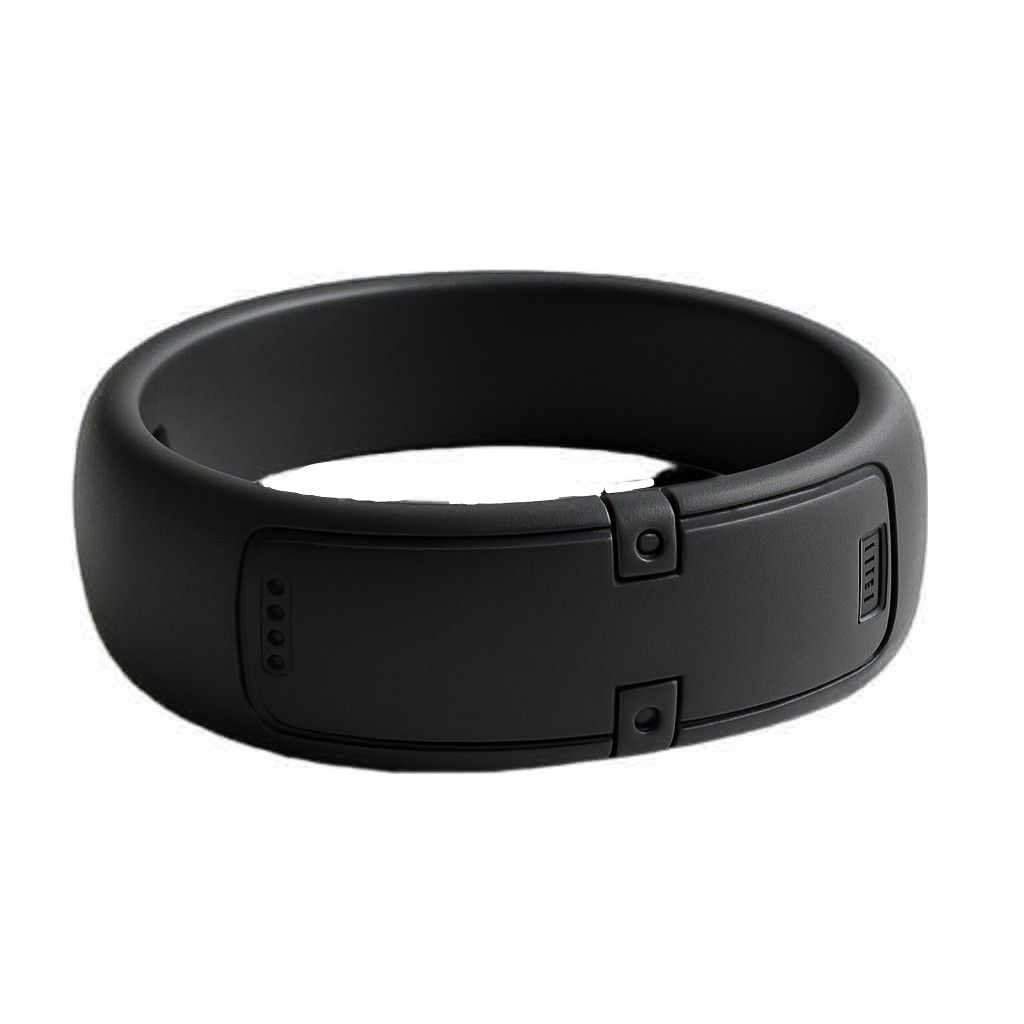
That decision is built into the object itself. SIX carries no buttons, no screen, no lights, and no interface of any kind. The band holds one uniform width the whole way around, with the electronics distributed through the circumference instead of concentrated in a housing, so there is no section of it that reads as a device. That is a clinical decision more than a cosmetic one. A visible housing categorizes the object as a watch or a medical monitor, and for someone carrying trauma that categorization is itself a cognitive event. The finish is matte black and anti-reflective so it does not draw a glance, the surface against the skin is medical-grade silicone chosen for continuous contact, and the whole object is plain enough to wear to work without explaining it to anyone. SIX is the first wearable to put every component inside a uniform band and abandon the device-plus-strap configuration that every other wearable is built on.
Privacy is built into the same logic. Sensing happens on the device and stays under the survivor's control. The microphone measures only the level and frequency of environmental sound and records no audio content. Location is read only at confirmed trigger events, not continuously. Processing runs on the wrist instead of in the cloud, which protects the survivor's data and lets the device keep working without depending on connectivity.
The whole system runs on roughly one hundred bytes. It holds no historical data, no pattern library, no trigger database, and no historical tracking of any kind. If someone opened the device memory they would find a few decimal numbers and the current readings. There is no record of past triggers to take.
Each of these choices serves the same end. Post traumatic stress has to be measured without turning the survivor's day into a medical performance, and without asking the survivor to surrender privacy in exchange for being believed.
It never comes off
I know that it doesn't happen at the clinic. I don't remember all the time. Nobody else remembers it. When cognitive decline is so bad that even if we do remember we won't be able to process it later. This is why it has dual batteries and it's waterproof — to stay on.
Two cells sit on opposite sides of the band so the weight is balanced, and the whole device, electronics and batteries together, weighs forty grams. A USB connector is built into each cell, so the cell is both the battery and the charging plug. There is no cradle and no cable. When the cell in use runs low, the phone says so. The wearer folds that cell out and the device carries straight on without interruption, so the sensors stay powered and the record is unbroken. The depleted cell goes into any USB port, a laptop, a wall adapter, a car, a battery bank, and charges in about an hour. One cell runs twenty-six hours; rotating the pair runs past fifty. The housing is medical-grade polycarbonate rated IP67, submersible to one metre for thirty minutes, so the band stays on through a shower, a swim, and the rain.
Triggers can occur at any time, day or night, and they are unpredictable by their nature. Wearables that require removal for charging create monitoring gaps where triggers go undetected and unsupported, and every one of those gaps is a hole in the clinical record. For that stretch of time the evidence does not exist, and neither the survivor nor the clinician can say what happened. The waterproof construction is part of the same answer. The band stays on through a shower, a swim, and everything else in an ordinary day, so there is never a moment it has to come off. This uninterrupted operation is the foundation upon which every other part of SIX depends.
This is what separates SIX from a wellness accessory. Post traumatic stress costs sleep, relationships, work, safety, and sometimes life itself, and it does so largely in private, where no record is kept and no witness is present. SIX exists to be that witness. Quiet, continuous, personal, and on the survivor's side.
What SIX is, and is not
SIX is built for adjunct monitoring and objective episodic evidence, not standalone psychiatric diagnosis. The device does not assign diagnostic labels, score severity categories, identify trigger causes, replace therapy or medication, or operate as a general wellness wearable. Extended monitoring may contribute useful clinical context when shared with a treating professional.